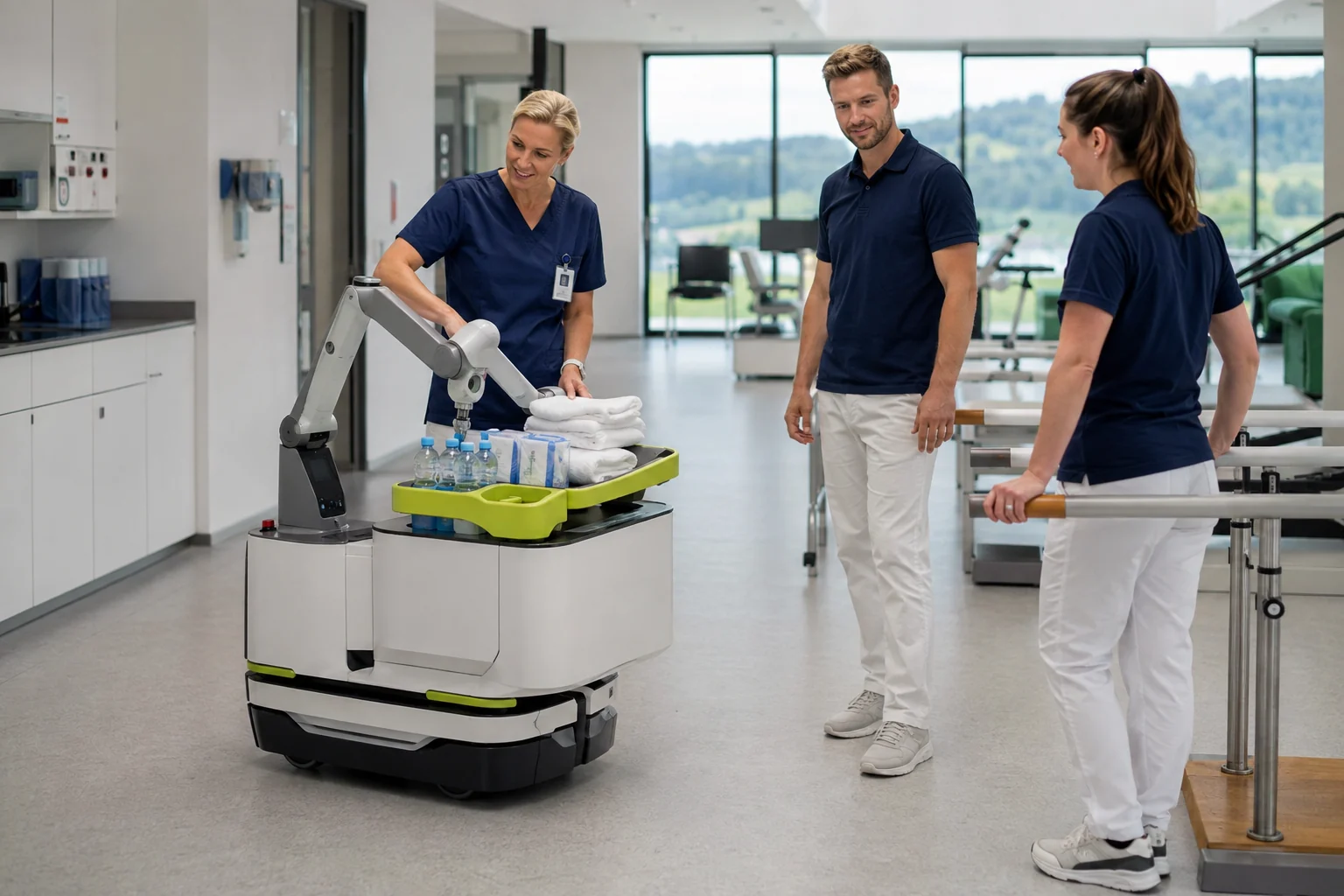
A fictional care team turns repeated supply trips into a clear brief, invites different ideas and tests whether a robot gives people more time for people.
REAL NEED → TESTABLE USE CASE
Designed forCare operators, clinical teams, procurement professionals and robotics providers
Key takeawayA useful care robot is shaped by a real workflow, clear safeguards and measurable relief—not by a catalogue of impressive features.
“
The goal is not to replace a caring conversation. It is to make sure nobody has to interrupt one just to fetch a towel.
01
Begin with an interruption, not a robot.
Imagine a rehabilitation centre where staff repeatedly leave residents to collect sealed supplies, water and fresh linen from another floor. Each trip is small. Together, they create interruptions, hurried handovers and less time at a resident's side.
The team does not begin with a preferred machine. It describes the current process, when the trips happen, what may be transported and what must always remain in human hands. The need is simple: reduce routine journeys without changing clinical responsibility.
02
Turn the frustration into a precise brief.
The useful details are wonderfully unglamorous. The system must use lifts, yield to people, move quietly, carry secure trays and request help when a route is blocked. It must fit through the real doors and work during the real shift—not only on a perfect demonstration floor.
The care team also states the limits. The robot does not diagnose, choose treatments or make medication decisions. Those responsibilities stay with qualified people.
Routes, doors, lifts and busy periods
Payload, hygiene and secure handover
Human approvals and escalation rules
Noise, speed and safe interaction
A measurable trial period
03
Invite more than one kind of answer.
Different providers can respond to the same need. One may propose a simple delivery robot. Another may add a small arm for loading. A third may recommend reorganising the supply stations before introducing any hardware.
That variety is valuable. It gives the care team options to compare and gives builders a clearer picture of the conditions their technology must satisfy. Communication replaces guesswork on both sides.
04
Test usefulness where the work happens.
A controlled trial measures reliable deliveries, staff interventions, blocked-route recovery and time returned to the care team. Residents and staff can report whether the robot feels predictable, understandable and appropriately quiet.
Success is not measured by applause during a demonstration. It is measured by fewer interruptions and more human attention where it matters.
05
Share what the trial teaches.
The result gives the provider concrete evidence for improving the product and gives other organisations a more realistic understanding of the use case. Limits are useful information too: a robot that handles supplies well does not need to pretend it can handle every part of care.
This is the kind of exchange VILEXI is designed to encourage: people describe real work, providers propose relevant approaches and both sides learn what useful technology looks like in practice.